
Uncertainty Avoidance at Work (U)
A-Z Series at Psychology@Work

In our dynamic world, a term echoes through the corridors of workplaces and leadership forums: VUCA. Born in the 1980s from the lexicon of the U.S. Army War College in the post-Cold War era, this acronym encapsulates the essence of our era: Volatility, Uncertainty, Complexity, and Ambiguity. It vividly depicts our global stage as unpredictable and spirited as a teenager. It is full of swift changes, unforeseen twists, and complex riddles.
VUCA in a Nutshell
Let's delve deeper into the essence of VUCA. Volatility speaks to the swift and seismic shifts that can turn our well-laid plans upside down in a heartbeat. Complexity weaves an intricate tapestry of interconnected factors, making it a Herculean task to discern clear patterns or predictions. Ambiguity adds an enigmatic layer, shrouding our reality in mystery, akin to a suspense novel where the next page is always a surprise and the hero and villain are not distinguishable. And Uncertainty? It's the ongoing saga of navigating life's incomplete puzzle, where every missing piece makes the picture ever more perplexing.
Uncertainty Avoidance and Low Tolerance for Ambiguity
Hofstede's cultural dimensions theory highlights UA as a cultural barometer measuring a society's collective nerve against the unknown. Parallel to UA as a culture's dimension, the concept of "Tolerance of Ambiguity (TOA)," refined by thinkers like Frenkel-Brunswik and McLain, focuses on the individual's compass in navigating ambiguity. It's a spectrum where aversion and attraction to the unknown mark the ends, reflecting our personal ease or unease with the absence of clear, predictable information.
High UA cultures are fortresses of structure and clarity, where laws and traditions reign supreme. In such cultures, on average individuals show low TOA and prefer the clear, the known, and the predictable. They prefer robust systems, clear guidelines, and a firm adherence to tradition and expertise.
On the other hand, those with low UA or high TOA embrace the fluid, the risky, and the diverse. They innovate, adapt, and view the unknown not as a threat but as an opportunity for growth and discovery. Low UA cultures are playgrounds of possibility, embracing the new, the nuanced, and the unknown with open arms.
While our societal backdrop significantly shapes our stance on uncertainty, our individual TOA adds another layer of complexity. Even within a high UA culture, you'll find mavericks (those with high TOA) who thrive amidst ambiguity.
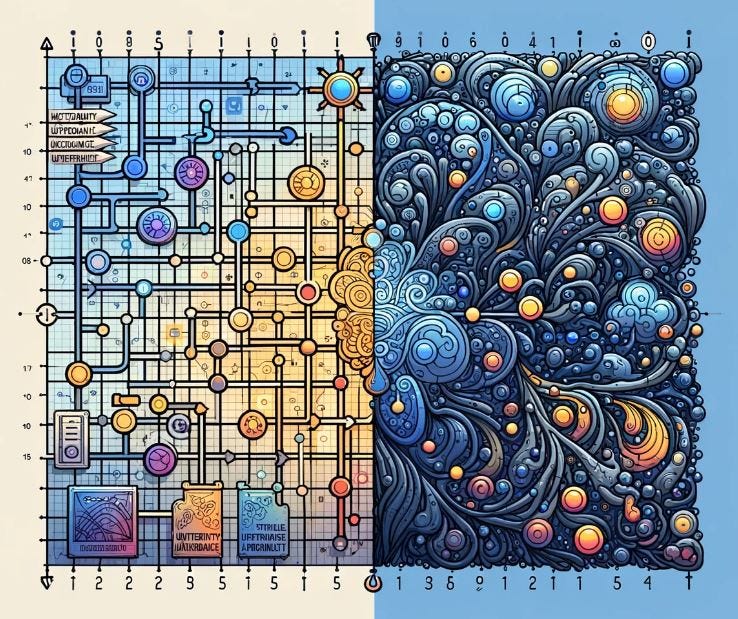
Research-Based Behaviours of Those High on Uncertainty Avoidance
Like seasoned gardeners in their well-tended gardens, individuals with High Uncertainty Avoidance and Low Tolerance of Ambiguity cultivate a life of stability, tradition, and precision. These individuals, deeply rooted in conservative and traditional values, prefer the familiarity of well-trodden paths to the unpredictability of uncharted territories. They approach life with a risk-averse and cautious mindset, meticulously planning and analyzing every decision, much like a gardener carefully selects seeds and plots out planting rows to ensure a bountiful harvest.
Their need for control and predictability mirrors a gardener's vigilance against the elements, as they are prone to higher levels of stress and anxiety, constantly on guard against the unknown pests and weather that might disrupt their orderly world.
Resistance to change is inherent in their nature; they prefer perennial plants' stability over annuals' fleeting beauty, often struggling with the chaos that transformation and innovation can bring. In their social environment, they thrive in cultural tightness and conformity, much like a garden that flourishes under a strict regime of pruning and weeding, ensuring that every plant conforms to the desired aesthetic. Their preference for detailed planning and extensive analysis is akin to a gardener's meticulous attention to soil composition, watering schedules, and sunlight exposure, ensuring that everything is perfectly aligned for optimal growth and minimal risk.
In essence, individuals with High Uncertainty Avoidance and Low Tolerance of Ambiguity navigate life with the precision and care of a master gardener, cultivating a world where every detail is controlled, every risk is calculated, and every change is approached with caution, ensuring that their life, like a well-maintained garden, remains orderly, predictable, and safe from the unpredictable whims of nature.
Why do you need to understand UA & TOA?
Understanding UA and TOA is not merely about cultural navigation but crafting a personal and collective strategy to thrive in uncertainty.
The impact of UA and TOA on workplace choices and decisions is profound and multifaceted. It influences organizational structures, leadership styles, team dynamics, and individual well-being. It impacts how decisions are made, how change is managed, and how people collaborate and communicate.
Understanding and navigating this complex terrain is crucial for fostering a workplace that is productive, psychologically supportive, and culturally attuned.
For example, the rapid pace of technological advancement (manifesting in you wanting to adopt latest AI tools at work) can clash with organizations and leaders in countries with high UA cultures, where the drumbeat of AI and tech change may seem dissonant with deeply ingrained traditions and a collective yearning for predictability and order. This friction can give rise to cultural tensions, demanding thoughtful and innovative adaptation strategies.
Leaders and teams are increasingly called upon to harmonize a symphony of cultural nuances, striking a delicate balance between the comfort of structure and the zest for innovation and flexibility. The ability to read the room to understand the unspoken language of cultural preferences and individual TOA preferences becomes a prized skill, enabling leaders to guide their diverse teams through projects and partnerships with a keen sensitivity to varied UA and TOA levels. In our VUCA world, recognizing and respecting these cultural and personal nuances is paramount. It's about choosing when to build bridges of clarity and when to sail the seas of ambiguity. It's about knowing when to hold fast to tradition and when to embrace the winds of change.
Strategic Approach to Managing Uncertainty
Understanding and utilizing the concept of uncertainty avoidance in the workplace is not about altering the cultural currents—it's about learning to sail effectively in diverse waters. It's about recognizing the invisible undercurrents that shape behaviors, attitudes, and workplace dynamics.
Advice for Leaders
Leaders need to be adept navigators, steering their teams through the swirling currents of Uncertainty Avoidance (UA) and Tolerance of Ambiguity (TOA). Like seasoned ship captains, influential leaders understand that mastering these waters is not about resisting the cultural tides but about charting a course that harnesses these forces to propel the organization forward.
They cultivate a Mastery Climate on deck, where learning is the north star, guiding every decision and action. They know when to take the helm with directive leadership, providing clarity amidst foggy ambiguity, and when to let the crew chart their own course, fostering trust and autonomy. In the galley of creativity and innovation, they encourage their crew to cook up storms of new ideas, understanding that a few overturned pots are part of discovering new flavors. Recognizing the unique compass each team member brings aboard, they tailor their approach, ensuring that every individual can navigate confidently in their own style. The role of leaders is to steer through the murky waters of ambiguity, turning potential challenges into opportunities for growth and innovation.
Leaders with a keen TOA are the lighthouses in uncertain times, illuminating paths to growth, learning, and creativity. Their ability to read the winds of change and adjust the sails accordingly makes them invaluable helmspersons, guiding their teams through uncharted waters to new horizons of success and innovation. In the vast ocean of modern business, these leaders chart a course that respects the currents of cultural nuances, ensuring that their vessel - the organization - not only weathers the storms but emerges stronger, riding the waves of uncertainty with skill, resilience, and vision.
Advice for Individual Employees
As a professional navigating the diverse global workplace, understanding Uncertainty Avoidance (UA) and Tolerance of Ambiguity (TOA) can be your compass in fostering solid relationships and enhancing productivity. Here's how you can practically apply this understanding in your day-to-day work life:
1. Tune into the Workplace Culture: Recognize if your workplace prefers a structured approach (high UA) or a flexible, innovative environment (low UA). This understanding will help you align your work style accordingly, whether following established protocols or taking the initiative to suggest new ideas.
2. Communicate with Precision or Flexibility: Understand how your workplace handles change. If you're in a high UA setting, prepare to approach changes methodically, with detailed planning and risk assessment. If your workplace embraces change (low UA), be ready to adapt quickly and contribute your ideas for innovative solutions. Adapt your communication style to match your workplace's cultural norms. In high UA environments, be clear and precise, leaving little room for ambiguity. Feel free to express your ideas more openly and creatively in more flexible settings.
3. Bridge Cultural Gaps: Celebrate the diversity of perspectives within your team. Embrace and learn from the different approaches your colleagues bring to the table. This enhances team cohesion and fosters a creative and inclusive environment. Be mindful of the emotional undercurrents in your team, especially in high UA environments. Offer support to colleagues under stress and seek support when you need it. A workplace where everyone feels understood and supported is critical to collective success.
4. Commit to Continuous Learning: The business world is ever-changing, and staying adaptable is crucial. Engage in continuous learning to keep your skills sharp and to understand the nuances of navigating cultural dimensions like UA and TOA. This proactive approach ensures you remain valuable and versatile in any professional setting.
By mastering these strategies, you can effectively manage your own and your team's preferences for UA and TOA, steering your career toward success and fulfillment in the multifaceted world of global business.